
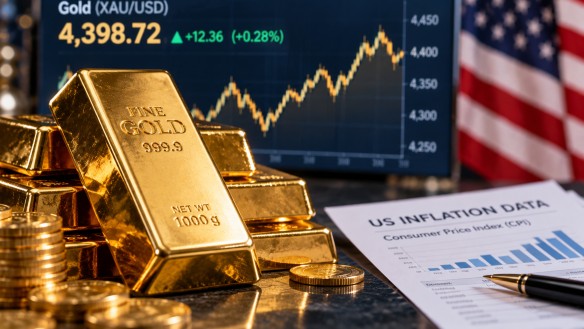
Gold prices are hovering near $4,400 an ounce as investors keenly await new US inflation figures, which could play a pivotal role in shaping expectations for the Federal Reserve’s forthcoming interest-rate decision. Spot gold experienced a modest rise of around 0.4%, reaching approximately $4,418.87 per ounce, while gold futures saw a slight increase to about $4,461.82. A downturn in the US dollar has contributed to the allure of the precious metal, as a weaker dollar makes gold priced in dollars more attractive to foreign investors.
The US Dollar Index saw a decline to around 98.74, benefiting gold since the metal becomes less costly for international buyers when the dollar weakens. However, the rise in US Treasury yields is exerting some pressure on gold prices. The 10-year Treasury yield climbed following plans to purchase up to $6 billion in longer-term government bonds. As government securities offer interest income and gold does not, rising yields can deter gold investments by increasing the opportunity cost of holding the metal.
In the broader financial landscape, oil prices have emerged as a significant variable, with Brent crude reaching near $100 a barrel, stoking fears of mounting inflationary pressures. Higher energy costs can escalate expenses for businesses and consumers alike, complicating efforts to manage inflation. As a result, investors are closely monitoring both oil and gold price movements to gauge the global economic outlook.
The upcoming US inflation data is under intense scrutiny, with the Producer Price Index set to be released ahead of the Consumer Price Index. A higher-than-expected inflation reading could bolster expectations for more stringent monetary policies, potentially impacting gold negatively. Conversely, if inflation figures are lower than anticipated, it could fuel predictions for reduced interest rates and potentially give gold prices a boost.
Amid these economic signals, geopolitical uncertainties continue to drive demand for safe-haven assets like gold. Ongoing tensions in the Middle East have prompted investors to remain cautious, maintaining their investments in assets that offer security. As gold trades near the $4,400 mark, its immediate future hinges on the interplay of a weaker dollar, safe-haven demand, and the counteracting effects of rising Treasury yields and inflation concerns. Investors are poised for the US inflation figures, which could sway the Federal Reserve’s next move and influence gold’s trajectory in the sessions ahead.